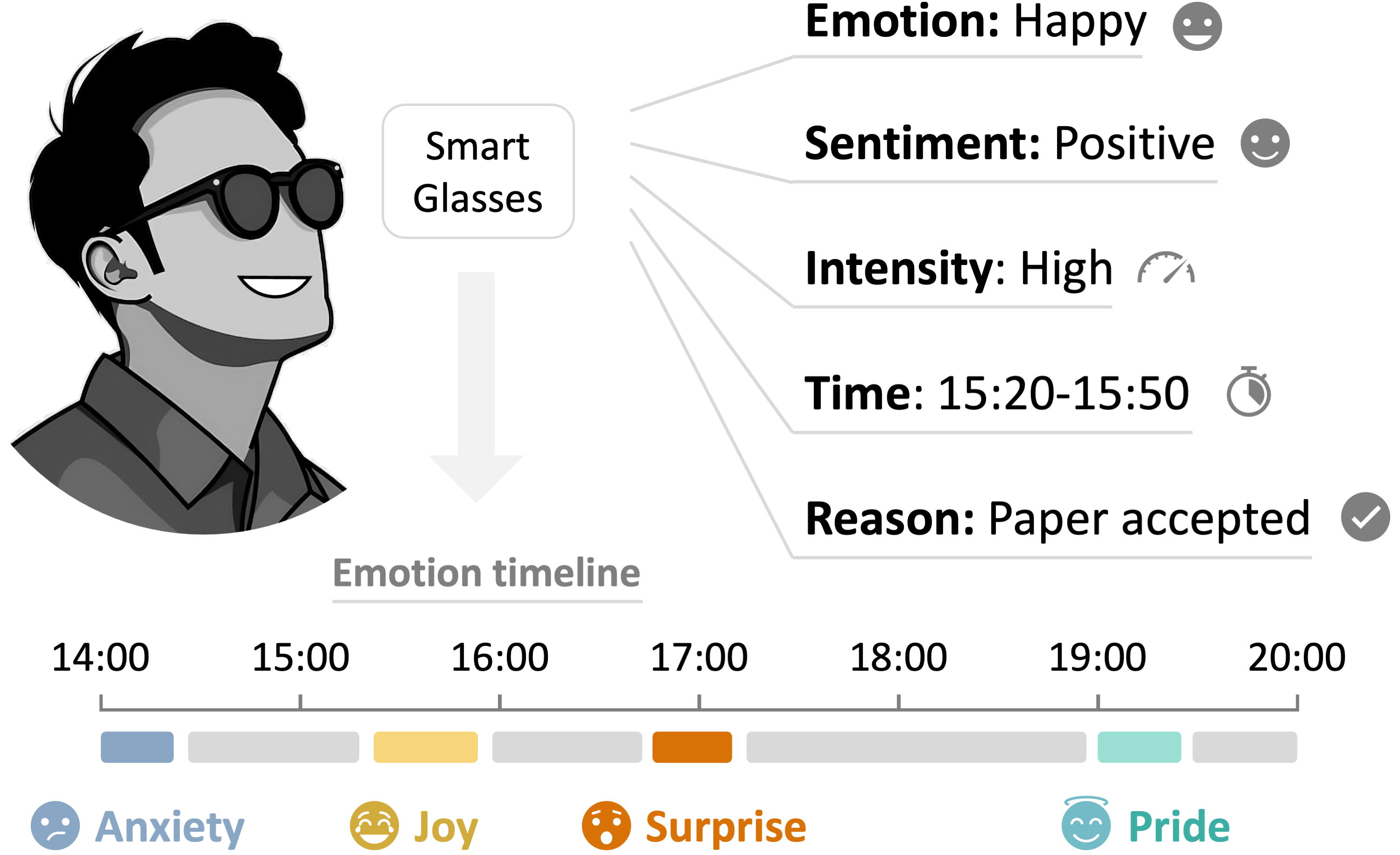
We introduce the novel task of egocentric self-emotion tracking,
which aims to infer an individual's evolving emotions from egocentric multimodal
streams such as voice, visual surroundings, semantic subtext, and eye-tracking signals.
To establish this research direction, we present:
(1) OSMO dataset,
a large-scale annotation effort on 110 hours of existing bilingual smart-glasses recordings,
establishing the largest egocentric emotion dataset and the first with subject-wise emotion timelines;
(2) OSMO benchmark, a suite of five tasks (emotion recognition, sentiment, intensity, localization, and reasoning),
that redefine emotion understanding as a continuous, context-aware process rather than discrete classification of trimmed videos;
(3) OSIRIS, a large multimodal model that tracks emotions over time by reasoning over the user's personal emotion history,
current expressions, and egocentric observations.
Extensive evaluations show that OSIRIS achieves a state-of-the-art performance,
delivering, for the first time, coherent emotion timelines from egocentric data.
Dataset, model, and codes will be fully open-sourced upon publication.